
is carnosine gel just menthol
The surge, the climb, the sprint.
Carnosine gel for cycling: LactiGo’s triple-blind trial ran on a bike ergometer and found 5–10% more peak power in repeated sprints. Race-day protocol.
Short answer
Carnosine gel suits cycling that is decided by repeated hard efforts: crits, track, MTB, cyclocross and attacking road finales. LactiGo’s 2025 triple-blind trial was run on a Wattbike, and peak power across twelve sprints was 5–10% higher than on a menthol-matched placebo. Apply 10 ml per leg 45 minutes before the start.
If you searched for a “lactic acid gel” for cycling, what you want is a rub-on buffer — and the one with a trial behind it is LactiGo, a carnosine gel you put on your quads and calves 45 minutes before the start. The best study on it was done on a bike. Seven world-class rugby sevens players did twelve flat-out 6-second sprints on a Wattbike cycle ergometer, once on LactiGo and once on a placebo with the same 1.25% menthol, and nobody knew which was which. Peak power was 5–10% higher on LactiGo in the authors’ summary, up to 1426 W vs 1270 W in sprint 7. That is the shape of a crit, a track session, an MTB race or the final hour of a road race: surge, recover, surge again. For long steady endurance it is not the right tool. For the efforts that win races, it is.
What is a “lactic acid gel” for cycling?
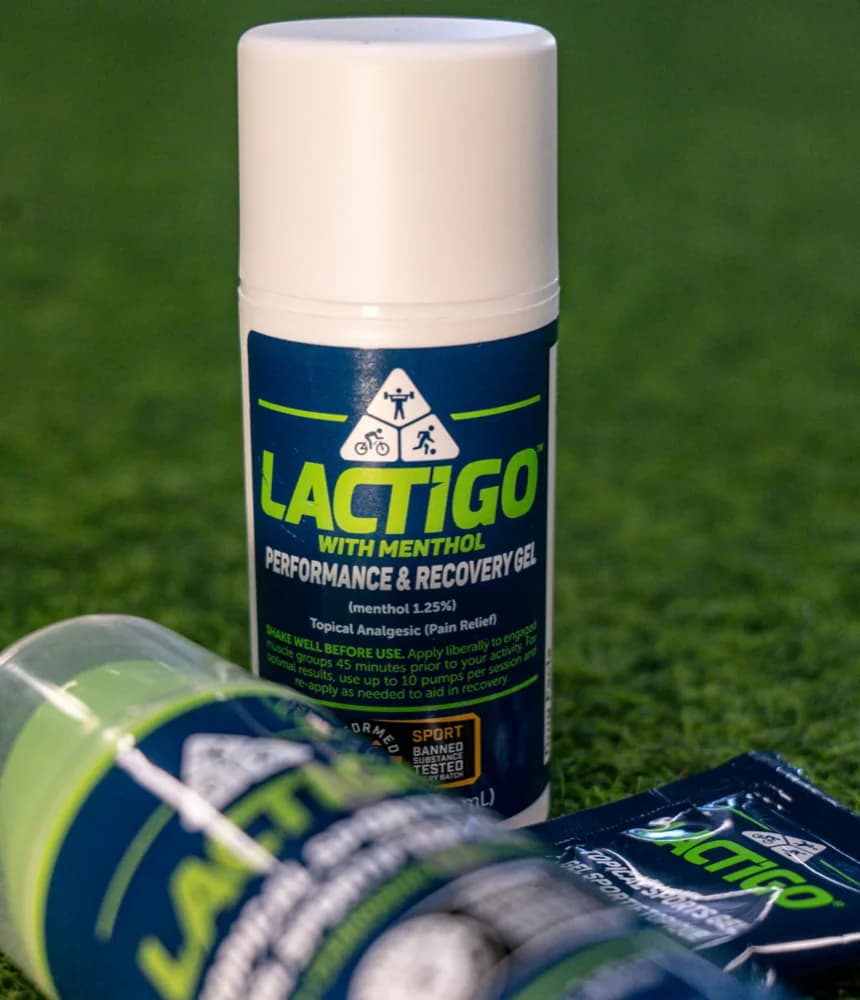
It is a gel you rub on your legs to buffer the acid that builds up during hard efforts — not a gel that contains lactic acid, and not an energy gel you eat. Riders use the phrase for products like LactiGo, which carries carnosine, a buffer your muscles already make, through the skin over the working muscle.
The name comes from the old idea that lactic acid is what makes your legs burn. The modern picture is that the acid of hard efforts is hydrogen ions, released faster than the muscle can clear them once you go above a pace you can hold. Carnosine is one of the muscle’s own buffers against exactly that. So the gel is aimed at the moment the effort gets hard, not at the steady miles in between.
Does carnosine gel work for cyclists?
Yes, for repeated maximal efforts — and the best trial on it was done on a bike. Beaven et al. 2025 tested seven world-class rugby sevens players on a calibrated Wattbike cycle ergometer: twelve rounds of 24 seconds at 3 W/kg, 6 seconds flat out and 30 seconds’ rest, with a two-minute break after the sixth. Each player did it once on LactiGo and once on a placebo gel with the same 1.25% menthol, applied 10 ml per leg, 45 minutes before.
- Peak power across the twelve sprints: 5–10% higher on LactiGo in the authors’ summary.
- Sprint 7: 1426 W vs 1270 W on placebo — an extra 156 W. Sprint 2: 1433 W vs 1332 W. Sprint 4: 1347 W vs 1244 W.
- The biggest single-sprint gap, 11.4%, came in sprint 10 — deep into the set, when the efforts had stacked up.
- Triple-blind: riders, testers and analysts did not know which gel was which until the statistics were done.
One study in trained male cyclists doing repeated 30-second Wingate tests saw no change — a reminder that this gel is built for short, repeated surges rather than steady endurance riding, and the 2025 authors note that peak wattages in that study fell outside the accurate range of the power meter used. Every trial, positive and null, is laid out on the evidence page.
Which kinds of cycling does it suit?
The kinds that are decided by surges: criteriums, track, mountain bike, cyclocross, and road races that come down to attacks on the climbs and a sprint. The trial protocol — 6 seconds flat out, 30 seconds’ rest, again and again — is close to a crit lap or a technical MTB loop, and a long way from a steady three-hour endurance ride.
| Riding | What the effort looks like | Fit with the evidence |
|---|---|---|
| Criterium | A sprint out of every corner, attacks, a bunch finish | Strong — repeated short maximal efforts |
| Track sprint and bunch races | All-out efforts with short recoveries | Strong — the trial ran on a bike ergometer |
| Mountain bike (XC, short track) | Punchy climbs, accelerations out of technical sections | Strong — stop-start, high intensity |
| Cyclocross | An hour of surges, remounts and sprints | Strong — repeated hard efforts |
| Road race with a hard finale | Steady miles, then attacks and a sprint | Good — the finale is what it targets |
| Hill repeats and interval sessions | Planned maximal reps with rest | Good — the same pattern as the trial |
| Steady endurance or a long time trial | Even power for hours | Weak — not what it was built or tested for |
How do you use carnosine gel on race day?
Put 10 ml on each leg — about ten pumps, over the quads and calves — 45 minutes before the start. That is the dose and timing the trial used. Work it in on clean, dry skin before you pull your bibs on, and let it dry.
| When | What to do |
|---|---|
| Start minus 45 minutes | Apply 10 ml per leg to quads and calves, rub in like sunscreen |
| Start minus 40 minutes | Kit on once it has dried; it leaves no sticky residue |
| If you wear sunscreen | The brand suggests LactiGo first, sunscreen about 30 minutes later |
| Start minus 30 to 10 minutes | Your normal warm-up with a few openers |
| Second race the same day | Apply again about 45 minutes before that start |
- Why reapply for a second race: in the absorption study, muscle carnosine was up at 30 and 60 minutes and back to baseline by 120. The trials tested one application; for a later start, treat it as a fresh one.
- Keep it on the big working muscles. The label says avoid skin folds and mucous membranes, so keep it well away from the chamois area.
- Test it in training first. Run a set of sprints or a hill-repeat session you already know, once without and once with the gel, and compare the numbers on your head unit.
Should cyclists use the menthol or menthol-free version?
Either — pick by feel. The trial’s placebo contained the same 1.25% menthol as LactiGo, so the power gain came from the carnosine, not the cooling. Some riders like the tingle on the start line; others prefer the menthol-free version, especially for long days in the sun or if menthol irritates their skin.
If you are wondering whether the cool feeling is the whole trick, this breakdown of the menthol-matched trial answers it.

Is LactiGo allowed in UCI racing?
Yes. UCI racing runs under the World Anti-Doping Code, and carnosine is not on the WADA prohibited list. Every batch of LactiGo is also Informed Sport tested for banned substances, and you can look up the batch number on your own bottle.
Racing under a testing programme? Our anti-doping page walks through the prohibited list and the batch lookup step by step.
How does carnosine gel compare with beta-alanine and bicarbonate for cyclists?
All three aim at the same thing — buffering the acid of hard efforts — but the gel is the only one that needs neither weeks of loading nor a stomach that tolerates baking soda. Beta-alanine needs 4–6 g a day for at least 2–4 weeks, and sodium bicarbonate is taken 60–180 minutes before and is known for gut trouble.
| Carnosine gel (LactiGo) | Beta-alanine | Sodium bicarbonate | |
|---|---|---|---|
| Route | On the skin | Swallowed daily | Swallowed before the race |
| Timing | 45 minutes before | 4–6 g a day for 2–4+ weeks | 60–180 minutes before |
| Dose | 10 ml per leg | 4–6 g a day | 0.2–0.5 g per kg of body weight |
| Known downside | None reported in the trials | Tingling (paraesthesia) | Bloating, nausea, vomiting, stomach pain |
| Best evidence for | Repeated sprints (triple-blind) | Efforts of 1–4 minutes | Efforts of 30 seconds to 12 minutes |
For a race this weekend that you did not load for, the gel is the one that can still help. The longer comparison is in carnosine gel vs beta-alanine.

Your next race
If your races are won and lost on the surges, LactiGo targets exactly that: tested triple-blind on a bike ergometer, 5–10% more peak power across repeated sprints, Informed Sport tested batch by batch. At the trial dose a 100 ml bottle covers about five race days — roughly $11 each.
Put it on 45 minutes before your next crit, cross race or hill session and watch the power file. It comes with a 30-day money-back guarantee — here is where to buy it.
Sources
- Topical carnosine gel improves intermittent high-intensity exercise performance in world-class rugby sevens players (Journal of the International Society of Sports Nutrition, 2025) (opens in a new tab) PMC12427510
The triple-blind, menthol-matched trial, run on a Wattbike cycle ergometer: the 5–10% peak power summary, the per-sprint figures and the 10 ml per leg, 45-minute protocol.
- Transdermal carnosine gel fails to improve repeated Wingate performance in trained male cyclists (Journal of Sports Science and Nutrition, 2023) (opens in a new tab) 10.33545/27077012.2023.v4.i2b.193
The null study in trained cyclists doing repeated Wingate tests — the reason this page draws the line at steady endurance riding.
- Transdermal delivery of carnosine into equine skeletal muscle (Comparative Exercise Physiology, 2021) (opens in a new tab) 10.3920/CEP200077
The absorption timeline — up at 30 and 60 minutes, back to baseline by 120 — behind the advice to reapply for a later start.
- Trexler et al. 2015 — ISSN position stand: beta-alanine (opens in a new tab) pmc.ncbi.nlm.nih.gov
The beta-alanine column: 4–6 g a day for 2–4 weeks or more, best in 1–4 minute efforts, tingling as the side effect.
- Grgic et al. 2021 — ISSN position stand: sodium bicarbonate and exercise performance (opens in a new tab) pmc.ncbi.nlm.nih.gov
The bicarbonate column: 0.2–0.5 g/kg taken 60–180 minutes before, efforts of 30 seconds to 12 minutes, and the gut side effects.
Ready to try it
LactiGo Performance & Recovery Gel, $55 for with menthol · 100 ml. Informed Sport tested, 30-day money-back guarantee.
Other questions
carnosine gel vs beta alanine
Carnosine gel vs beta-alanine: 45 minutes vs 4 weeks
carnosine gel for horses
Carnosine gel for horses: Fortigo and the absorption study
does carnosine gel work
Does carnosine gel work? What the trials and athletes show
lactigo vs carnosport
LactiGo vs Carnosport: which carnosine gel is tested?
best carnosine gel
The best carnosine gel in 2026 (and why it is not close)
carnosine gel for bjj
Carnosine gel for BJJ: a bigger gas tank in late rounds
carnosine gel australia
Carnosine gel in Australia: how to get LactiGo
carnosine gel side effects
Carnosine gel side effects: what to know before you use it
carnosine gel vs biofreeze
Carnosine gel vs Biofreeze: cooling vs performance
lactigo review
LactiGo review: does it work, and is it legit?
lactigo price
LactiGo price: what it really costs per session
lactigo vs pr lotion
LactiGo vs PR Lotion: carnosine gel vs bicarb lotion
is lactigo banned
Is LactiGo banned? WADA, drug tests and Informed Sport
lactigo ingredients
LactiGo ingredients: what is in it, menthol vs Original
can you absorb carnosine through skin
Can you absorb carnosine through skin? What studies show
lactigo vs sportlegs
LactiGo vs SportLegs: carnosine gel vs lactate capsules
menthol before workout
Menthol before a workout: does it actually help?
why do muscles burn during exercise
Why do muscles burn during exercise? (Not lactic acid)
The product
Try it yourself
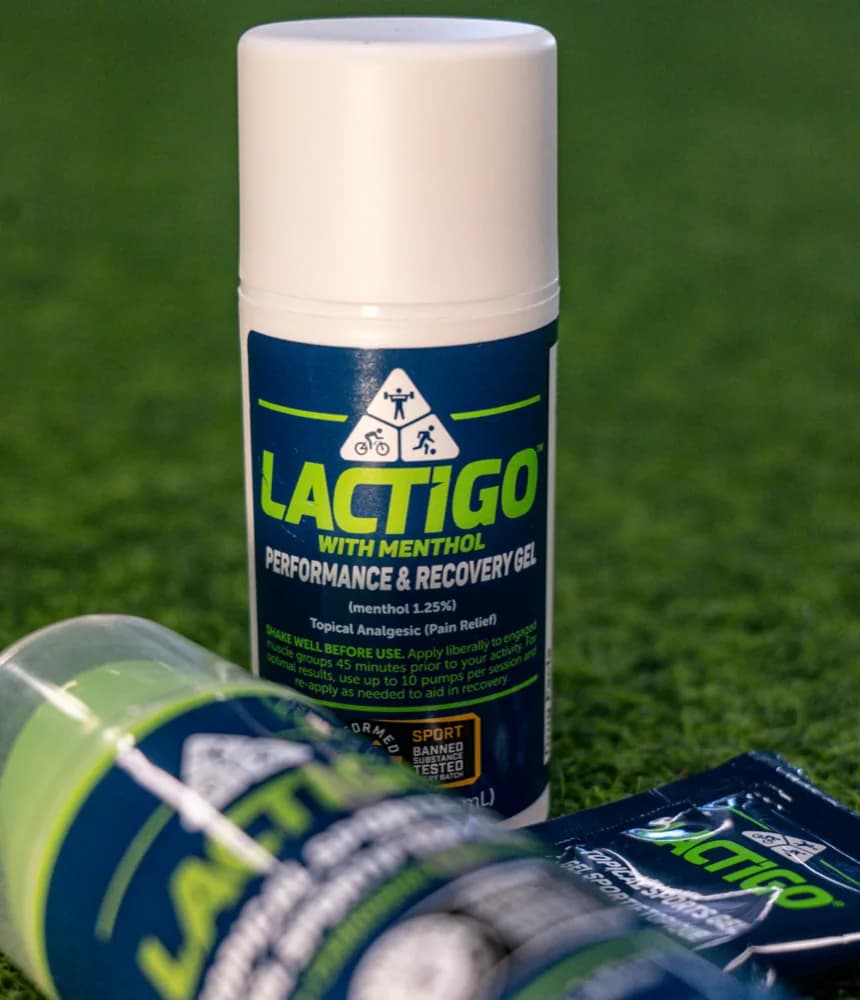
LactiGo Performance & Recovery Gel
Ten pumps a leg, forty-five minutes out. That is the whole method.
$55with menthol · 100 ml · about 5 sessions
30-day money-back guarantee
Affiliate links. We earn a commission if you buy — it costs you nothing extra and does not change what we publish.
- Informed SportEvery batch tested
- 30 daysMoney-back guarantee
- 16,500+Athletes, per the brand
- 45 minApply before training