
is carnosine gel just menthol
Menthol feels fast. Does it make you fast?
Menthol before a workout gives a small, mostly perceived boost across 16 studies. What it misses, and why LactiGo beat a menthol-matched placebo.
Short answer
A little. A 2026 meta-analysis of 16 studies found rub-on menthol gives a small performance boost, mostly in endurance exercise and mostly through feeling cooler. LactiGo’s 2025 triple-blind trial put the same 1.25% menthol in its placebo, and peak power in repeated sprints was still 5–10% higher on the carnosine gel.
Menthol before a workout helps a little, and mostly in your head — which is not nothing. A 2026 meta-analysis pooled 16 studies and 191 participants and found that rubbing menthol on the skin gives a small but real performance improvement, strongest in aerobic endurance exercise in temperate conditions and weaker in the heat. It works through perception: you feel cooler and rate the effort as easier, while your core temperature does not change. What menthol has not been shown to do is protect top-end power when hard efforts stack up. That is the gap carnosine gel fills. LactiGo’s 2025 trial gave its placebo the same 1.25% menthol, so both gels tingled identically — and peak power across twelve sprints was still 5–10% higher on LactiGo. Use menthol for feel; use carnosine gel for the efforts that decide the session.
Does menthol before a workout improve performance?
Slightly. Wang et al. 2026 pooled 16 studies with 191 participants and found topical menthol produced a small but significant improvement in exercise performance, an effect size of 0.27. The benefit was clearest in aerobic endurance exercise, with rub-on application, in temperate conditions, and it faded in heat of 30 °C and above.
| What was measured | Effect of topical menthol | Size |
|---|---|---|
| Exercise performance | Improved | Small (g = 0.27) |
| Thermal sensation | Felt cooler | Moderate (g = −0.74) |
| Perceived exertion | Effort felt easier | Small (g = −0.35) |
| Thermal comfort | Slightly more comfortable | Small (g = 0.34) |
| Core body temperature | No change | — |
The authors concluded the benefit is context dependent and most relevant for endurance exercise, working mainly through the sensation of cooling rather than any real drop in temperature.
How does menthol work before exercise?
It changes how the effort feels, not how hot you are. In the meta-analysis, menthol made people feel cooler and rate the work as easier, while core body temperature stayed where it was. In a long, steady effort, feeling better can let you hold a pace a little longer — which is where the small performance effect showed up.
That also explains its limits. A cool feeling on the skin does nothing about the acid that builds inside the muscle during repeated all-out efforts, and in hot conditions the effect largely disappeared.
Is it okay to use Icy Hot or Biofreeze before a workout?
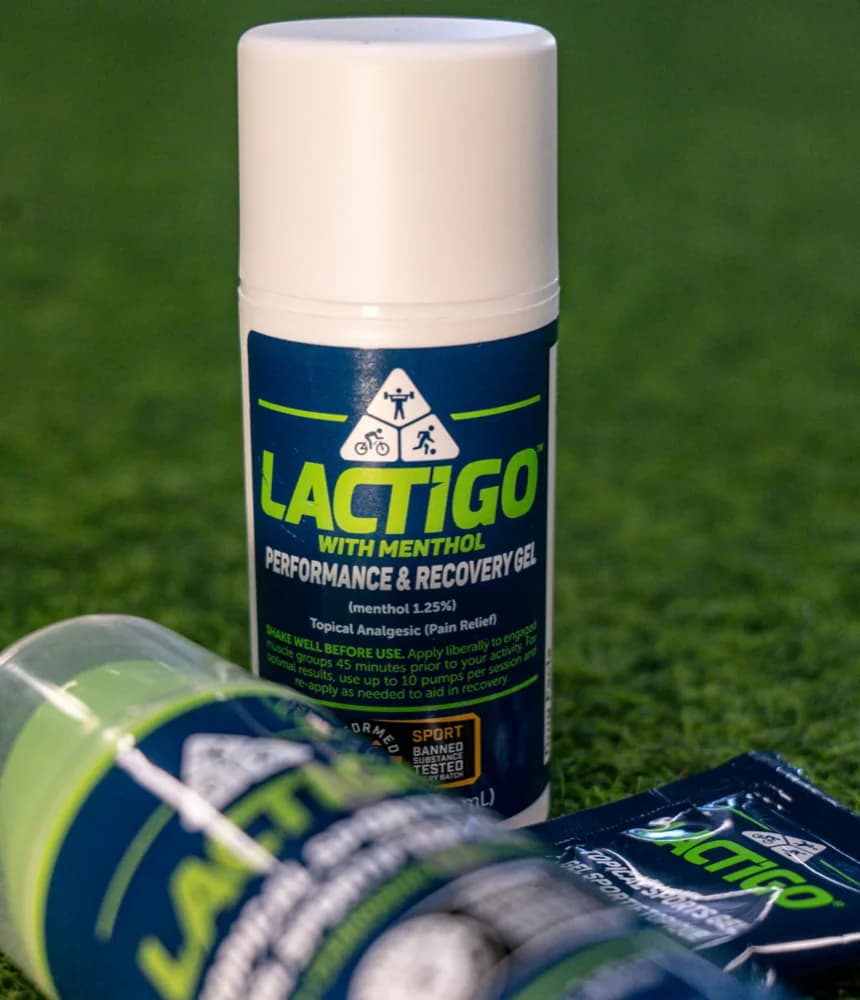
Menthol rubs like Icy Hot and Biofreeze are sold as topical pain relievers for minor aches, and the pre-workout evidence on menthol is the meta-analysis above: a small effect, mostly on how endurance work feels. If you use one, follow its label. LactiGo’s own menthol label, for example, warns against broken or irritated skin, heating pads and tight bandaging.
What a menthol rub will not give you is a buffer. If the reason you reached for it is legs that die in the last rounds or sprints, carnosine gel vs Biofreeze explains the difference.
Does menthol help muscle recovery?
Menthol’s established use is temporary relief of minor muscle aches — that is what it is labelled for. The meta-analysis looked at performance during exercise, not recovery afterwards, so there is no evidence here that menthol speeds recovery itself.
LactiGo’s standard version carries that same label use: it is registered in the US as an over-the-counter topical analgesic, 1.5% menthol, for the temporary relief of minor aches and pains of muscles and joints. So the menthol in the bottle does the job menthol is known for, and the carnosine is there for the performance side.
Why did LactiGo’s trial put menthol in the placebo?
To prove the result was not the menthol. Beaven et al. 2025 gave seven world-class rugby sevens players two unlabelled gels: LactiGo, and a placebo with the same 1.25% menthol, matched for smell. Both tingled the same, and nobody — players, testers or analysts — knew which was which until the statistics were done.
- Peak power across twelve maximal sprints: 5–10% higher on LactiGo in the authors’ summary.
- Sprint 7: 1426 W vs 1270 W. Sprint 2: 1433 W vs 1332 W. Sprint 4: 1347 W vs 1244 W.
- Four of the seven players thought the placebo day was their better one. The blinding held; the power meter still saw the difference.
Same menthol in both bottles means menthol cannot explain the gap. Is carnosine gel just menthol? goes through the design in full.

Does menthol work in the heat?
Less well. In the meta-analysis, the performance benefit of topical menthol diminished in hot conditions of 30 °C and above — exactly when athletes most want to feel cooler. The cooling sensation is still there; it just stopped translating into better performance.
That fits how menthol works. It makes you feel cooler without lowering your core temperature, and when the heat is real, a feeling does not go very far. If you race or train in summer heat, a menthol rub is a comfort, not a plan.
When should you use a menthol rub and when carnosine gel?
Use a menthol rub when you want the feel — cooling, comfort, minor aches. Use carnosine gel when the session is decided by repeated hard efforts: sprints, rounds, intervals, surges. That is what its trial measured.
| Your goal | Menthol rub | Carnosine gel (LactiGo) |
|---|---|---|
| Feel cooler on a long, steady effort | Good fit — the meta-analysis effect | Standard version has menthol too |
| Hold power across repeated sprints or rounds | Not shown | Triple-blind trial: 5–10% more peak power |
| Temporary relief of minor muscle aches | Yes — the labelled use | Yes — standard version, same label use |
| Train or race in the heat (30 °C +) | Effect largely gone | The carnosine does not rely on cooling |
| Close-contact sport, or menthol irritates you | Not an option | Menthol-free version |
Can you use menthol and carnosine gel together?
You do not need to: standard LactiGo already contains 1.5% menthol, so it gives the cooling feel and the carnosine in one application. Layering another menthol rub on top adds nothing the trial tested, and the label says to apply only as directed.
If you want the carnosine without the tingle — sensitive skin, grappling, or a hot day when menthol does little anyway — the menthol-free version is the same carnosine formula without it.

The bottom line on menthol before a workout
Menthol makes a workout feel easier and gives a small boost in endurance work. It does not buffer the acid that kills your power in repeated hard efforts. LactiGo does both jobs: the menthol for the feel, and the carnosine that beat a menthol-matched placebo by 5–10% in peak power.
Apply 10 ml per leg 45 minutes before your next hard session — the protocol page has the details — and try it with the 30-day money-back guarantee. Here is where to buy it.
Sources
- Wang et al. 2026 — Acute topical menthol application and exercise performance: systematic review and meta-analysis (Journal of Thermal Biology) (opens in a new tab) ro.ecu.edu.au
What topical menthol does on its own: 16 studies, 191 participants, a small performance effect (g = 0.27), mostly in endurance work and through perceived cooling.
- Topical carnosine gel improves intermittent high-intensity exercise performance in world-class rugby sevens players (Journal of the International Society of Sports Nutrition, 2025) (opens in a new tab) PMC12427510
The trial that matched its placebo for 1.25% menthol, and the source of the 5–10% peak power summary.
- DailyMed — LACTIGO menthol gel label (US FDA) (opens in a new tab) dailymed.nlm.nih.gov
The registered label: menthol 1.5% as a topical analgesic for temporary relief of minor aches, the warnings and the full ingredient list.
Ready to try it
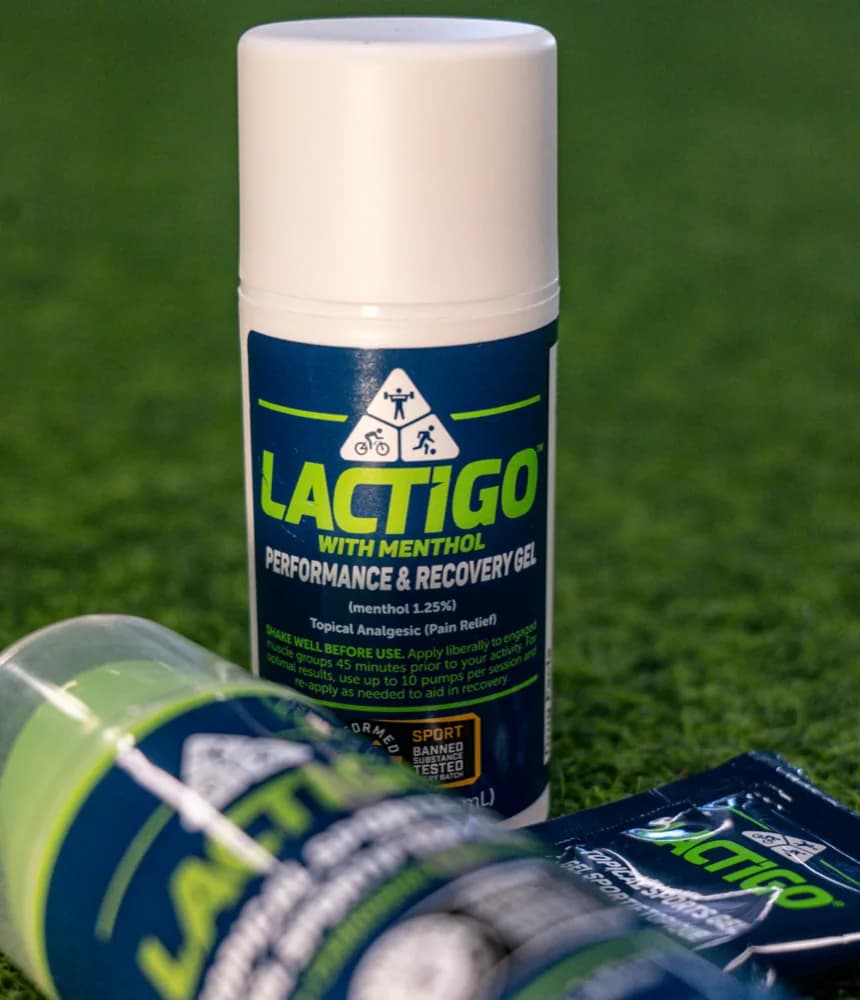
LactiGo Performance & Recovery Gel, $55 for with menthol · 100 ml. Informed Sport tested, 30-day money-back guarantee.
Other questions
carnosine gel vs beta alanine
Carnosine gel vs beta-alanine: 45 minutes vs 4 weeks
carnosine gel for horses
Carnosine gel for horses: Fortigo and the absorption study
does carnosine gel work
Does carnosine gel work? What the trials and athletes show
lactigo vs carnosport
LactiGo vs Carnosport: which carnosine gel is tested?
best carnosine gel
The best carnosine gel in 2026 (and why it is not close)
carnosine gel for bjj
Carnosine gel for BJJ: a bigger gas tank in late rounds
carnosine gel australia
Carnosine gel in Australia: how to get LactiGo
carnosine gel side effects
Carnosine gel side effects: what to know before you use it
carnosine gel vs biofreeze
Carnosine gel vs Biofreeze: cooling vs performance
lactigo review
LactiGo review: does it work, and is it legit?
lactigo price
LactiGo price: what it really costs per session
lactigo vs pr lotion
LactiGo vs PR Lotion: carnosine gel vs bicarb lotion
is lactigo banned
Is LactiGo banned? WADA, drug tests and Informed Sport
lactigo ingredients
LactiGo ingredients: what is in it, menthol vs Original
carnosine gel for cycling
Carnosine gel for cycling: LactiGo for sprints and surges
can you absorb carnosine through skin
Can you absorb carnosine through skin? What studies show
lactigo vs sportlegs
LactiGo vs SportLegs: carnosine gel vs lactate capsules
why do muscles burn during exercise
Why do muscles burn during exercise? (Not lactic acid)
The product
Try it yourself
LactiGo Performance & Recovery Gel
Ten pumps a leg, forty-five minutes out. That is the whole method.
$55with menthol · 100 ml · about 5 sessions
30-day money-back guarantee
Affiliate links. We earn a commission if you buy — it costs you nothing extra and does not change what we publish.
- Informed SportEvery batch tested
- 30 daysMoney-back guarantee
- 16,500+Athletes, per the brand
- 45 minApply before training