
is carnosine gel just menthol
The burn is not lactic acid.
Why do muscles burn during exercise? Hydrogen ions and other by-products of hard efforts. Buffering options compared, and LactiGo’s 5–10% power result.
Short answer
Muscles burn during hard exercise because they release hydrogen ions faster than they can clear them, and nerves in the muscle sense that acid together with lactate and ATP. Lactic acid is not the villain. Buffers push the burn back: LactiGo carnosine gel lifted peak power 5–10% in a triple-blind trial.
Your muscles burn during exercise because, once you go harder than a pace your aerobic system can cover, they break down ATP faster than they can rebuild it aerobically — and that releases hydrogen ions, which makes the muscle more acidic. Sensory nerves in the muscle pick up the combination of acid, lactate and ATP and report it as fatigue and, as levels climb, as the burn. Lactic acid is not the cause: lactate production actually slows acidosis down. The burn is a signal that you are working above a pace you can hold. You cannot switch it off, but you can push it later with training, pacing and buffers — beta-alanine over weeks, sodium bicarbonate on the day, or carnosine gel on the skin. In a 2025 triple-blind trial, LactiGo carnosine gel lifted peak power across repeated sprints by 5–10%.
Why do your muscles burn during exercise?
Because hard efforts make your muscles more acidic, and nerves in the muscle sense it. Every time a muscle breaks down ATP for energy, a hydrogen ion is released. At an easy pace your mitochondria use those ions up. Push beyond a steady pace and the muscle leans on faster, non-aerobic energy systems — and hydrogen ions build up faster than they can be cleared.
The sensation itself comes from sensory nerves inside the muscle. In a 2014 human study, researchers infused tiny amounts of exercise by-products into a thumb muscle. Acid alone, lactate alone or ATP alone produced nothing. The three together, at the levels found in moderate exercise, produced fatigue; at the levels of vigorous exercise, stronger fatigue and some ache; higher still, more ache.
Is lactic acid what makes your muscles burn?
No — that is the old explanation. For most of the last century, lactic acid was blamed for both the acid and the burn. A widely cited 2004 review found no biochemical support for lactate production causing acidosis: the acid comes from ATP breakdown, and producing lactate actually slows acidosis down.
Lactate still rises when you work hard, which is why it became the scapegoat — it is a good marker of the conditions that make the muscle acidic, not the culprit. The review’s authors go further: if muscle did not produce lactate, acidosis and fatigue would arrive sooner.
| Old story | Current understanding |
|---|---|
| Lactic acid floods the muscle and causes the burn | Hydrogen ions from ATP breakdown make the muscle acidic |
| Lactate is the cause of the acid | Lactate production slows acidosis; it is a marker, not the culprit |
| One chemical causes the sensation | Nerves respond to acid, lactate and ATP together |
What does it mean when your muscles burn?
It means you are working above an intensity you can sustain. The burn arrives when energy demand outruns the aerobic system — a hard climb, the tenth rep, a sprint, a long scramble — and it eases when you back off and your muscles catch up.
That kind of burn is a normal part of hard training. Sharp or stabbing pain, pain in a joint, or pain that does not settle once you stop is something else — stop and get it checked rather than training through it.
Why does the burn slow you down?
Because the same acid build-up tracks with fatigue: as hydrogen ions accumulate, the muscle struggles to keep producing top-end power, and each hard effort costs a little more than the last. That is why buffering the acid is a real performance lever and not just a comfort one.
The best evidence for that is what buffers do. Raising muscle carnosine with beta-alanine improves all-out efforts of 1–4 minutes; sodium bicarbonate improves high-intensity work lasting 30 seconds to 12 minutes. Both act on the acid, and both show up where the burn is worst.
How do you stop muscle burn during a workout?
You cannot switch it off — and you would not want to, because it is useful information — but you can push it later in the effort. Training, pacing and buffers all do that.
- Train at the intensity that burns. Intervals and hill repeats are the most reliable way to make that pace feel less brutal over a training block.
- Pace it. Going out too hard is the fastest way to meet the burn early. An even effort delays it.
- Use your rest. Longer recoveries between sets or sprints let the muscle clear more before the next effort.
- Warm up properly. Start easy and build, rather than going from cold straight into a maximal effort.
- Add a buffer for the sessions that count. More on the options below.

Which supplements buffer muscle acid?
Three with real evidence: beta-alanine, sodium bicarbonate and carnosine gel. They differ mostly in how long they take and what they cost you in side effects.
| Beta-alanine | Sodium bicarbonate | Carnosine gel (LactiGo) | |
|---|---|---|---|
| How it buffers | Raises muscle carnosine over weeks | Raises the blood’s buffering capacity | Delivers carnosine through the skin |
| Dose | 4–6 g a day | 0.2–0.5 g per kg (0.3 g/kg optimal) | 10 ml per leg |
| Timing | At least 2–4 weeks of daily loading | 60–180 minutes before | 45 minutes before |
| Side effects | Tingling (paraesthesia) | Bloating, nausea, vomiting, stomach pain | None reported in the trials |
| Best evidence for | All-out efforts of 1–4 minutes | High-intensity efforts of 30 s to 12 min | Repeated sprints (triple-blind) |
Beta-alanine is a long project; carnosine gel vs beta-alanine compares the two. Bicarbonate is effective but hard on the stomach, which is why rub-on bicarbonate exists — LactiGo vs PR Lotion looks at how well that works.
Does carnosine gel help with muscle burn?
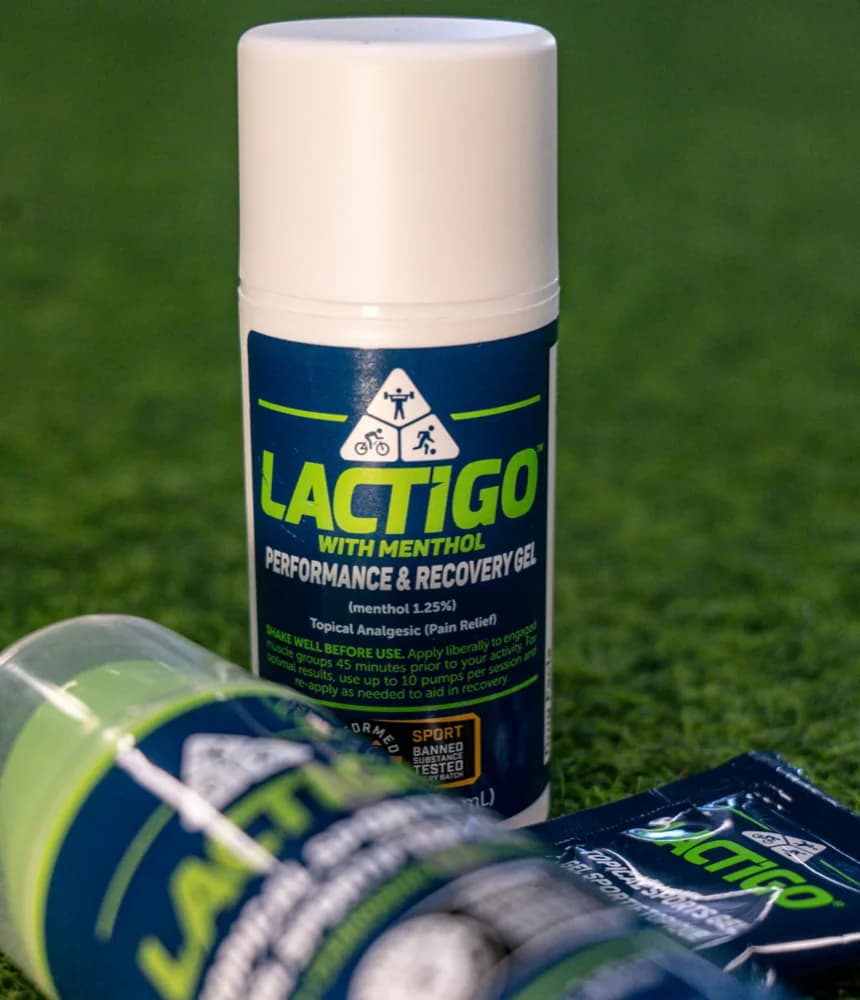
It targets the cause of the burn — the acid — and the trial measured what that is worth: power. Carnosine is one of the muscle’s own buffers, and LactiGo delivers it through the skin over the working muscle. In Beaven et al. 2025, world-class rugby sevens players produced 5–10% more peak power across twelve maximal sprints on LactiGo than on a placebo with the same menthol.
- Sprint 7: 1426 W vs 1270 W — an extra 156 W, halfway through the set.
- The biggest gap, 11.4%, came in sprint 10, when the efforts had piled up and the burn is at its worst.
- The trial measured power, not how much it burned. The honest promise is more power when the burn arrives.
In racehorses, topical carnosine raised muscle carnosine about 35% above placebo within 30 minutes, which is why the gel goes on 45 minutes before. All the trials are on the evidence page.
Is muscle burn the same as next-day soreness?
No. The burn happens during the effort and eases soon after you stop. Next-day soreness builds up a day or two after a hard or unfamiliar session and is a different thing, on a different timescale.
For the aches afterwards, standard LactiGo is also labelled for the temporary relief of minor muscle aches, thanks to its menthol.

Push the burn back
The burn is acid, and acid can be buffered. LactiGo is the fastest way to do it: no loading, no stomach trouble, 10 ml per leg 45 minutes before — and a triple-blind trial showing 5–10% more peak power across repeated sprints. Every batch is Informed Sport tested.
Put it on before your next hard session and see how much later the burn costs you. It comes with a 30-day money-back guarantee — here is where to get it.
Sources
- Robergs et al. 2004 — Biochemistry of exercise-induced metabolic acidosis (opens in a new tab) journals.physiology.org
Why lactic acid is not the cause: acidosis comes from ATP breakdown, and lactate production slows it down.
- Pollak et al. 2014 — Exogenously applied muscle metabolites synergistically evoke sensations of muscle fatigue and pain in human subjects (opens in a new tab) pmc.ncbi.nlm.nih.gov
Where the sensation comes from: acid, lactate and ATP together — not any one alone — evoked fatigue and then ache in a dose-dependent way.
- Trexler et al. 2015 — ISSN position stand: beta-alanine (opens in a new tab) pmc.ncbi.nlm.nih.gov
The beta-alanine column: 4–6 g a day for weeks, best in 1–4 minute efforts, tingling as the side effect.
- Grgic et al. 2021 — ISSN position stand: sodium bicarbonate and exercise performance (opens in a new tab) pmc.ncbi.nlm.nih.gov
The bicarbonate column: 0.2–0.5 g/kg, 60–180 minutes before, efforts of 30 seconds to 12 minutes, and the gut side effects.
- Topical carnosine gel improves intermittent high-intensity exercise performance in world-class rugby sevens players (Journal of the International Society of Sports Nutrition, 2025) (opens in a new tab) PMC12427510
The carnosine gel column: 5–10% more peak power across repeated sprints against a menthol-matched placebo.
Ready to try it
LactiGo Performance & Recovery Gel, $55 for with menthol · 100 ml. Informed Sport tested, 30-day money-back guarantee.
Other questions
carnosine gel vs beta alanine
Carnosine gel vs beta-alanine: 45 minutes vs 4 weeks
carnosine gel for horses
Carnosine gel for horses: Fortigo and the absorption study
does carnosine gel work
Does carnosine gel work? What the trials and athletes show
lactigo vs carnosport
LactiGo vs Carnosport: which carnosine gel is tested?
best carnosine gel
The best carnosine gel in 2026 (and why it is not close)
carnosine gel for bjj
Carnosine gel for BJJ: a bigger gas tank in late rounds
carnosine gel australia
Carnosine gel in Australia: how to get LactiGo
carnosine gel side effects
Carnosine gel side effects: what to know before you use it
carnosine gel vs biofreeze
Carnosine gel vs Biofreeze: cooling vs performance
lactigo review
LactiGo review: does it work, and is it legit?
lactigo price
LactiGo price: what it really costs per session
lactigo vs pr lotion
LactiGo vs PR Lotion: carnosine gel vs bicarb lotion
is lactigo banned
Is LactiGo banned? WADA, drug tests and Informed Sport
lactigo ingredients
LactiGo ingredients: what is in it, menthol vs Original
carnosine gel for cycling
Carnosine gel for cycling: LactiGo for sprints and surges
can you absorb carnosine through skin
Can you absorb carnosine through skin? What studies show
lactigo vs sportlegs
LactiGo vs SportLegs: carnosine gel vs lactate capsules
menthol before workout
Menthol before a workout: does it actually help?
The product
Try it yourself
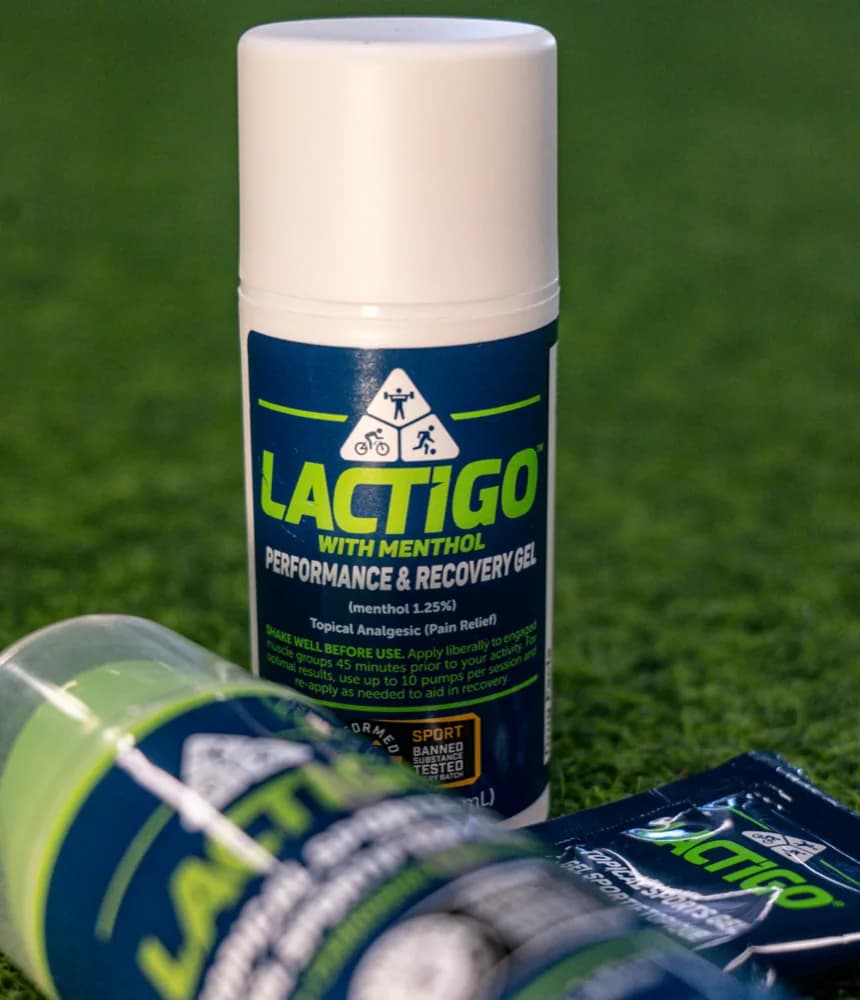
LactiGo Performance & Recovery Gel
Ten pumps a leg, forty-five minutes out. That is the whole method.
$55with menthol · 100 ml · about 5 sessions
30-day money-back guarantee
Affiliate links. We earn a commission if you buy — it costs you nothing extra and does not change what we publish.
- Informed SportEvery batch tested
- 30 daysMoney-back guarantee
- 16,500+Athletes, per the brand
- 45 minApply before training