is carnosine gel just menthol
Does it actually work?
Four controlled trials and twelve field reports, with the protocol and the measured number on every one. Including the reasons to discount them.
Short answer
Carnosine gel works for one measured thing: peak power in repeated maximal efforts. The strongest trial, published in 2025, was triple-blind against a placebo matched for menthol. It found peak power higher on the gel in three of twelve sprints — the only three to reach statistical significance. Those were +7.6%, +8.3% and +12.3%, with effect sizes of 0.99, 0.74 and 0.98. Mean power, heart rate and perceived exertion did not change at all. Four trials exist in total; one, in trained cyclists, found no effect on anything it measured, and two of the remaining three share authors with the manufacturer. Outside the lab the reports are consistent about something no trial has tested: more total work at the same effort, and less soreness the next day. Twelve of those reports are below with the protocol and the number attached. None are controlled, and nobody in that group reported nothing, which is itself a reason to discount them.
What the controlled trials found
Four trials exist. Three report a benefit, one reports nothing at all, and only two were run by people with no stake in the product. The best of them, Beaven et al. 2025, is the one worth your time: triple-blind, crossover, seven world-class rugby sevens players, and a placebo that was ultrasound gel spiked with 1.25% menthol so both bottles tingled identically.
- Peak power across 12 × 6-second maximal efforts: 8–12% higher on the gel.
- Mean power, heart rate, perceived exertion: no change.
- Four of seven athletes finished believing the placebo day was their better one.
- One of the four trials, on trained cyclists, found no effect on anything it measured.
That is a narrow finding and it is worth stating narrowly. The gel moved the top end of repeated efforts. It did not move the average, and it did not make anything feel easier.
What twelve people reported outside the lab
These are coaches, grapplers and weekend athletes who tested it and wrote back. Not blinded, not controlled, and every one of them knew what they were putting on. What makes them worth publishing is that each entry carries a protocol and, where the person tracked one, a number.
| Who | Sport | Protocol | What changed |
|---|---|---|---|
| Skye E. | Strength & power | Same session a week apart, gel on week two | ~17–27% higher peak strength loading, 16.7% more fast running, for 1.1% more WHOOP strain |
| Joe E. | Basketball & strength | Every two hours across a weekend | 215 lb front squat at lifetime-PR form; self-rated soreness down roughly half per application |
| Brendon | Basketball | Four-day tournament, six games | No usual lower-leg wreckage, and no central fatigue between games |
| Mitch D. | Surfing & gym | Light application before and after training | No next-day soreness after a heavy leg session |
| Grant B. | Strength training | Liberal application, 45 minutes before | Roughly 45 minutes of extra work after the planned session ended |
| Eamon F. | Brazilian jiu-jitsu | Daily for one week | Faster recovery between rolling rounds |
| Jorge Q. | Tumbling | Applied the same day as a bad landing | Self-rated discomfort 8/10 to 2/10 the next day |
| Anthony T. | Jiu-jitsu | Before training, two days running | Barely any next-morning stiffness — plus mild headaches on the first two days |
The full set, with each person’s words unedited, is on the results page.
Three things that repeat across the reports
- More work at the same cost. Extra sets, extra minutes, an extra game — described as capacity rather than as feeling better. Skye E. is the only one who put a strain number against it, and 1.1% more strain for 16.7% more fast running is the shape of the whole pattern.
- Less next-day soreness. Named by almost everyone, usually after the session they expected to pay for.
- Sleep, unprompted. Two people raised it without being asked. No trial has measured it and there is no mechanism on offer, so treat it as an observation, not a claim.
Notice what is missing. Nobody reported lifting more weight on the first set, and neither did the trials. Grant B. said it plainly — he did not feel able to lift much more than normal, he just kept going far longer than usual.
How much weight to give the field reports
Not one person in that group reported nothing. On a real sample that would be impossible. It tells you exactly what the group is: people who chose to test it and then chose to write in. Everyone who tried it, felt nothing and said nothing is invisible here, and there is no way to know how many that is.
The reason to keep reading the field reports anyway is that they are specific in a way marketing copy is not, and they point at an effect the trials never tested for: total work over a weekend, not peak power over 30 seconds.
The protocol every good report shares
- Apply it early. 45 minutes between the gel and the first hard effort — the timing every trial that found anything used, and the one Grant B. waited out deliberately.
- Use enough. Around ten pumps per large muscle group. The people reporting nothing much tend to be the people applying a smear.
- Reapply across long days. Joe E. went every two hours through a tournament weekend; Brendon reapplied across four days of games.
- Test it the way Skye E. did. Repeat a session you have already done, same exercises, same order, one week apart. It is not blinded, but it beats a feeling.
So does it work?
For repeated maximal efforts, in a blinded trial, against a placebo that tingled the same: yes, at the top end, by 8–12%, with nothing else moving. For training capacity across a hard week: consistently reported, never controlled, and worth one honest month of your own before you believe it.
What it is not is a painkiller or a treatment for anything. Reports that framed it that way were left off the results page on purpose. It is a gel for training, and the claim it can defend is a narrow one.
Sources
- Topical carnosine gel improves intermittent high-intensity exercise performance in world-class rugby sevens players (Journal of the International Society of Sports Nutrition, 2025) (opens in a new tab) PMC12427510
Every lab number in this article: the 8–12% peak power result, the unchanged mean power, and the menthol-matched placebo.
- Transdermal carnosine gel fails to improve repeated Wingate performance in trained male cyclists (Journal of Sports Science and Nutrition, 2023) (opens in a new tab) 10.33545/27077012.2023.v4.i2b.193
The trial that found nothing. It is in the count of four and it is why the answer above is narrow.
- Evaluation of the efficacy of LactiGo™ topical gel as an ergogenic aid (Journal of Exercise Physiology Online, 2016) (opens in a new tab) J Exerc Physiol Online 19(3):15–23
The manufacturer-linked 2016 paper behind the advertised 4% figure.
- Transdermal delivery of carnosine into equine skeletal muscle (Comparative Exercise Physiology, 2021) (opens in a new tab) 10.3920/CEP200077
The absorption evidence, in horses — the closest thing to a demonstrated mechanism.
Ready to try it
LactiGo Performance & Recovery Gel, $55 for with menthol · 100 ml. Informed Sport tested, 30-day money-back guarantee.
Other questions
carnosine gel vs beta alanine
Carnosine gel vs beta-alanine
carnosine gel for horses
Carnosine gel for horses
lactigo vs carnosport
LactiGo vs Carnosport
best carnosine gel
The best carnosine gel
carnosine gel for bjj
Carnosine gel for BJJ
carnosine gel australia
Carnosine gel in Australia
carnosine gel side effects
Carnosine gel side effects
carnosine gel vs biofreeze
Carnosine gel vs Biofreeze
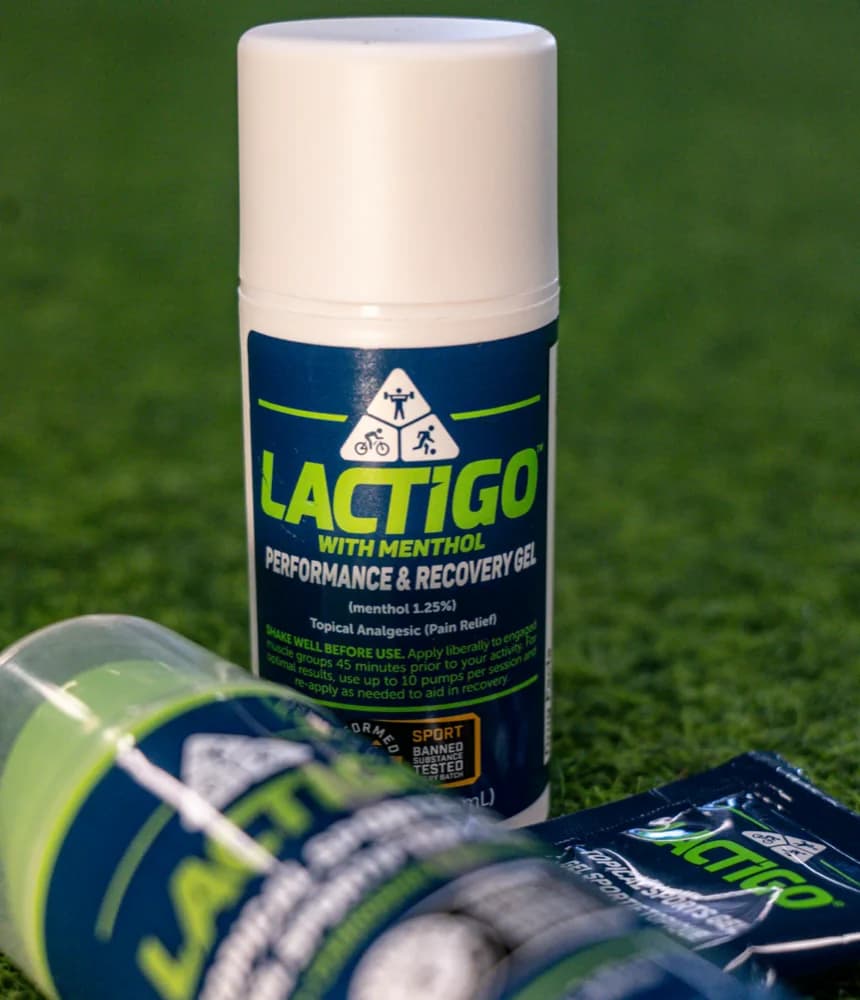
The product
Try it yourself
LactiGo Performance & Recovery Gel
Ten pumps a leg, forty-five minutes out. That is the whole method.
$55with menthol · 100 ml · about 5 sessions
Affiliate links. We earn a commission if you buy — it costs you nothing extra and does not change what we publish.
- Informed SportEvery batch tested
- 30 daysMoney-back guarantee
- 16,500+Athletes using it
- 45 minTo effect