
is carnosine gel just menthol
Carnosine benefits: what human studies actually show.
Carnosine benefits ranked by evidence: muscle, brain, skin, blood sugar. Human trial sizes, oral vs topical, safety, and LactiGo gel’s 7-player trial.
Affiliate links. We earn a commission if you buy — it costs you nothing extra and does not change what we publish.
Short answer
Carnosine’s best-established benefit is in muscle: it helps keep muscle pH steady during hard efforts, and beta-alanine raises it by up to 64% in four weeks. Brain, blood-sugar and skin benefits rest on small or lab studies. As a topical gel, LactiGo lifted peak power 5–10% in one triple-blind trial of seven players; mean power did not change.
Carnosine is a small molecule built from two amino acids, beta-alanine and histidine, and your body stores most of it in skeletal muscle. Its best-documented job is there: it is one of the ways working muscle keeps its pH steady when a hard effort makes it more acidic. Raising it with beta-alanine — 4–6 g a day for at least two to four weeks — improves all-out efforts of about 1–4 minutes, according to the International Society of Sports Nutrition. Beyond muscle, the picture gets thinner fast. Carnosine is an antioxidant and blocks sugar damage to proteins in the lab; small human trials, of 30 to 54 people, have tested it on blood sugar and memory; skincare work is mostly on skin samples in a dish. Swallowed carnosine is largely broken down in the blood before it gets anywhere. The topical route is the newest: in a 2025 triple-blind trial, seven international rugby sevens players produced 5–10% more peak power on LactiGo gel than on a placebo with the same menthol, in the authors’ summary. Below, every benefit is graded by the human evidence behind it.
What is carnosine?
Carnosine is a dipeptide — two amino acids, beta-alanine and histidine, joined together — that your body makes and stores, mostly in skeletal muscle. It was discovered in 1900 as an abundant compound of meat, and it is also found in other excitable tissue such as the brain.
Your muscle builds it from those two parts. Beta-alanine is the bottleneck — the rate-limiting building block — which is why sports nutrition focuses on beta-alanine rather than carnosine itself. You will also see “L-carnosine” on labels — that is the same molecule, named for its natural form.
What does carnosine do in the body?
In muscle, it helps hold pH steady during hard efforts. Carnosine is one of the muscle’s own buffers: when you go flat out, the muscle produces hydrogen ions faster than it clears them, and carnosine binds some of them, so the muscle turns acidic more slowly. That role is established physiology.
A 2013 review in Physiological Reviews, which traces a century of research on carnosine, lists its other chemical properties: it is an antioxidant, it binds metal ions, and it protects proteins against glycation — the slow reaction between sugars and proteins that forms damaged compounds called advanced glycation end-products. Most of that has been shown in test tubes and animals. The review calls the early results in diabetes, eye disease, ageing and brain disorders promising and says far more work is needed.
The burn of a hard effort and where carnosine fits in it is covered in why muscles burn during exercise.
Which carnosine benefits are backed by human studies?
Only one is strong: raising muscle carnosine with beta-alanine to improve short, all-out efforts. Everything else is limited — small human trials — or lab-only. Here is each claimed benefit, graded by the human evidence we could check.
| Benefit | Best human evidence | Grade |
|---|---|---|
| Higher muscle carnosine | Beta-alanine, 4–6 g a day: up to 64% more after 4 weeks, up to 80% after 10 (ISSN position stand) | Strong |
| Short, all-out efforts | Beta-alanine for 2–4+ weeks: clearest in efforts of 1–4 minutes (ISSN position stand) | Strong |
| Oral carnosine reaching the blood | 60 mg/kg in 25 people: a measurable rise in only 8 (Everaert 2012) | Limited |
| Blood sugar | 12-week trials in 30 adults with overweight (pilot) and 54 with type 2 diabetes | Limited |
| Memory | 39 older adults, a 3:1 anserine/carnosine mix for 3 months | Limited |
| Antioxidant and anti-glycation | Test-tube and animal work; one blood marker fell in the 54-person diabetes trial | Lab mostly |
| Skin | Skin samples in a dish, in a study by the cream’s maker | Lab only |
| Peak power from a topical gel | LactiGo: one independent triple-blind trial, n=7; one null trial in cyclists | Limited |
| Autism, “detox” or chelation, anti-ageing | Nothing we could verify to a standard worth citing | Not shown |
Does carnosine help exercise performance?
Yes — when muscle carnosine is raised with beta-alanine, and mainly in short, all-out work. The International Society of Sports Nutrition’s position stand concludes that 4–6 g of beta-alanine a day raises muscle carnosine significantly within four weeks, and that daily use for at least 2–4 weeks improves performance, most clearly in efforts lasting 1–4 minutes.
- It takes weeks: muscle carnosine climbs slowly, by up to 64% after 4 weeks and up to 80% after 10 weeks in the studies the position stand reviews.
- People respond differently: some raise their muscle carnosine far more than others on the same dose.
- The only reported side effect is tingling (paraesthesia), which smaller split doses reduce.
That is the case for carnosine as a sports molecule. The trade-off is time: weeks of daily loading before anything changes. Carnosine gel vs beta-alanine compares that route with a gel applied on the day.
Do oral carnosine supplements work?
Not as well as the label suggests, because swallowed carnosine is mostly broken down before it gets anywhere. An enzyme in the blood, serum carnosinase, splits carnosine back into beta-alanine and histidine — so a carnosine capsule works largely as a roundabout dose of beta-alanine.
In Everaert et al. 2012, 25 healthy people took a single large dose, 60 mg per kilogram of body weight. Only 8 of the 25 showed any measurable rise in blood carnosine; the other 17 had more of the enzyme. A 2025 study of 16 healthy volunteers found blood carnosine peaked within the first hour and little was detectable after four hours.
That is the reason other routes exist: beta-alanine lets the muscle build its own, and a gel goes on the skin over the muscle. Whether carnosine gets in from the skin has been measured only in horses so far.
Does carnosine help the brain and memory?
Possibly, but the human evidence is small and early. In a 2016 double-blind trial, 39 healthy adults aged 60–78 took 1 g a day of a mix that was three parts anserine — a close relative — to one part carnosine, for three months. Delayed verbal recall was better preserved than on placebo, and the authors call for further study.
Whether oral carnosine even gets to the brain was measured in 2025: in five healthy volunteers, brain carnosine rose an hour after a dose and was back to baseline by five hours. That study was funded by an investment firm, and two of its authors were company employees. Neither trial shows that carnosine prevents or treats any brain condition.
Does carnosine lower blood sugar?
Two small trials suggest an effect on blood-sugar markers; neither shows it is a treatment. In a 2016 pilot trial, 30 non-diabetic adults with overweight or obesity took 2 g of carnosine or placebo daily for 12 weeks; the rise in fasting insulin and insulin resistance seen on placebo was smaller on carnosine.
In a 2018 trial of 54 people with type 2 diabetes, 1 g a day for 12 weeks lowered fasting glucose by 13.1 mg/dL and HbA1c by 0.6 percentage points compared with placebo, and lowered one glycation marker; fasting insulin and insulin resistance did not change. If you have diabetes or take glucose-lowering medication, do not change anything on the strength of these — talk to your doctor.
What are the benefits of carnosine for skin?
Skincare brands use carnosine against glycation, and the best-known evidence is on skin samples, not faces. In a 2018 study, carnosine in solution applied to human skin explants — skin kept alive in a dish — cut one glycation product (CML) by 64% in the outer layer and 41% in the deeper dermis, and another (pentosidine) by 48% and 42%.
Several authors worked for ISDIN, the company that makes the cream tested, and a dish is not a face: the study did not measure how skin looks. That is why we describe carnosine skincare as what brands use it for, not as a result shown on faces. It is also a separate product from a sports gel.

What foods are high in carnosine?
Meat and poultry. Carnosine is a compound of animal muscle, so it comes in through muscle you eat; the beta-alanine your body uses to make its own also comes mainly from meat and poultry.
Diet shows up in your stores. In a study of 149 people measured by MRI spectroscopy, vegetarians had 26% less carnosine in the calf muscle than meat-eaters. Men had more than women, and levels fell with age. Beta-alanine is the usual way vegetarian athletes raise it.
Is zinc carnosine the same as L-carnosine?
No. Zinc carnosine, also sold as polaprezinc, is zinc bound to L-carnosine — a different compound, marketed for the stomach and gut, with its own separate research. Nothing on this page applies to it, and nothing about zinc carnosine applies to muscle or a sports gel.
What is carnosine gel?
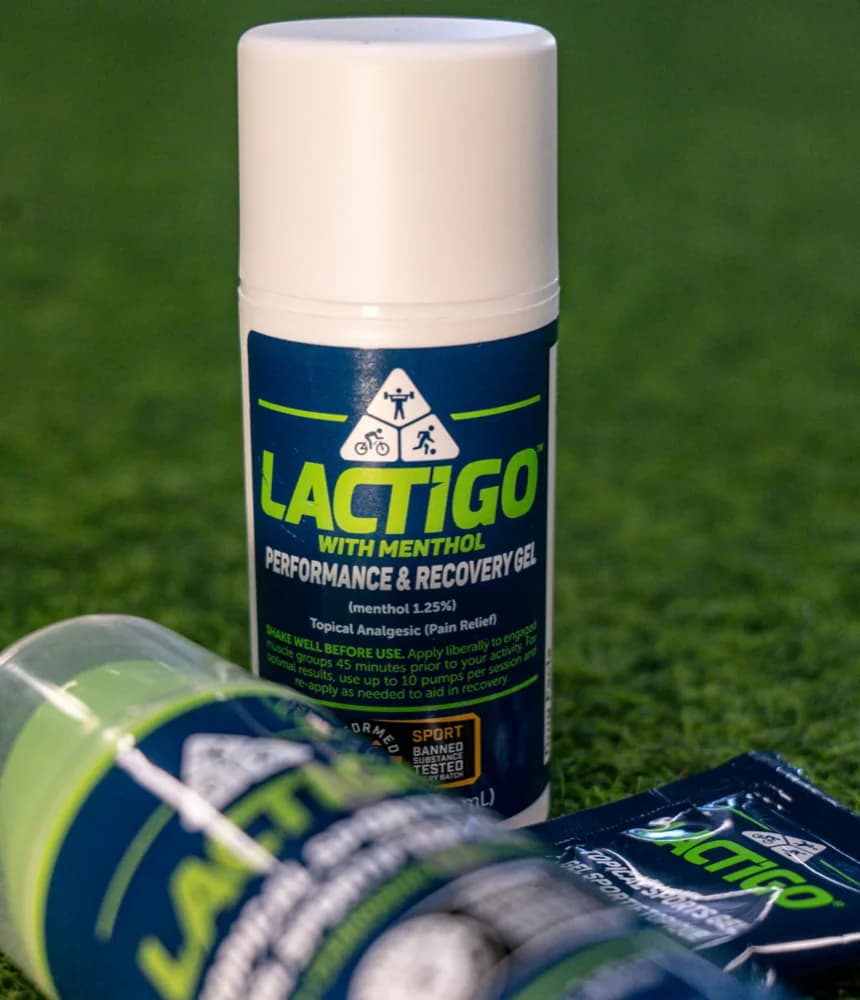
Carnosine gel is carnosine in a topical gel, applied to the skin over the working muscle before training instead of swallowed. LactiGo is the one that has been through trials: a 100 ml pump bottle of L-carnosine and magnesium sulfate, with or without menthol, used at about ten pumps a leg 45 minutes before a hard session. Every trial is on the carnosine gel evidence page.
| Study | Who, n | What it found | Who ran it |
|---|---|---|---|
| Beaven 2025 | International rugby sevens players, n=7 | Peak power 5–10% higher across repeated sprints, per the authors; significant in sprints 2, 4 and 7 of 12. No change in mean power, heart rate or perceived effort. | Independent |
| Sharpe 2016 | Serie A footballers, n=11 | Average time over three all-out 1000 m runs about 4% faster with LactiGo added to a warm-up cream | Industry-affiliated |
| Dieter 2021 | Racehorses, n=10 | Muscle carnosine about 35% above placebo at 30 minutes, about 46% at 60 | Industry-affiliated |
| Harnish 2023 | Trained male cyclists | No change in repeated Wingate sprints | Independent |
The 2025 trial’s placebo carried the same 1.25% menthol, so the tingle cannot explain the difference — is carnosine gel just menthol? walks through it. How the gel works is not established: the authors saw the effect from the first sprints and suggest it appears to be independent of intracellular buffering.
What does the evidence not show?
It does not show most of what carnosine is sold for. The strong evidence covers one thing — beta-alanine raising muscle carnosine for short, all-out efforts. Here is what nobody has shown:
- That swallowing carnosine raises muscle carnosine as reliably as beta-alanine does.
- That carnosine prevents or treats diabetes, dementia, autism or any other condition. The human trials measured markers in 30 to 54 people.
- That carnosine skincare changes how faces look; the glycation work was on skin samples.
- That carnosine from a gel gets to human muscle. That transfer has been measured only in ten racehorses, in a study co-authored by LactiGo staff.
- How the gel raises peak power. The 2025 trial saw no change in mean power, heart rate or perceived effort, and only seven players finished it.
- Any effect of the gel on long, steady efforts or on how you feel the next day. No trial has measured either.
Our full read of the gel trials, including the null cyclist study, is in does carnosine gel work?
Who should not take L-carnosine?
Check with your doctor or pharmacist first if you are pregnant or breastfeeding, take any medication, have a medical condition such as diabetes, or are buying for a child. The human safety data on carnosine supplements is small, and the trials cited here enrolled adults, not pregnant women or children.
What is known: in the 2025 safety study of 16 healthy volunteers, single oral doses up to 10 g were well tolerated; at 15 g, 77% had side effects, mostly headache, nausea and tingling. The ISSN considers beta-alanine safe in healthy people at recommended doses, with tingling the only reported side effect.
A gel is a different exposure: rubbed on the skin, not grams swallowed. LactiGo carries the standard menthol-gel label warnings — external use only, not on wounds or damaged skin, keep away from the eyes — and its Canadian licence says to consult a health care practitioner before use if you are pregnant or breastfeeding. Carnosine gel side effects has the full list.

The benefit you can test yourself
Most carnosine benefits are still lab chemistry. The one you can check in a week is peak power in repeated sprints: LactiGo is the gel tested triple-blind on seven international rugby sevens players, with 5–10% more peak power than a menthol-matched placebo in the authors’ summary, and every batch is Informed Sport tested.
Apply it 45 minutes before a session you know well and compare your numbers. Get LactiGo with menthol, or the menthol-free version if you would rather skip the tingle. First time buying? You get 10% off your first order through our link, and LactiGo’s 30-day money-back guarantee covers the bottle.
Sources
- Trexler et al. 2015 — ISSN position stand: beta-alanine (opens in a new tab) pmc.ncbi.nlm.nih.gov
Beta-alanine raises muscle carnosine (up to 64% at 4 weeks, 80% at 10), improves 1–4 minute efforts, and is safe in healthy people with tingling as the only reported side effect.
- Boldyrev, Aldini & Derave 2013 — Physiology and pathophysiology of carnosine (Physiological Reviews) (opens in a new tab) doi.org
What carnosine is and does: found in muscle and other excitable tissue, abundant in meat, with antioxidant, metal-binding and anti-glycation properties shown mostly in the lab.
- Everaert et al. 2012 — Low plasma carnosinase activity promotes carnosinemia after carnosine ingestion in humans (opens in a new tab) doi.org
Why oral carnosine struggles: after 60 mg/kg, only 8 of 25 people showed a measurable rise in blood carnosine.
- Ali et al. 2025 — Dietary carnosine supplementation in healthy human volunteers: safety, tolerability, plasma and brain concentration (Nutrients) (opens in a new tab) pmc.ncbi.nlm.nih.gov
Safety in 16 volunteers (tolerated to 10 g, side effects common at 15 g), blood levels gone by four hours, and a brief rise in brain carnosine in five people.
- Hisatsune et al. 2016 — Effect of anserine/carnosine supplementation on verbal episodic memory in elderly people (opens in a new tab) pmc.ncbi.nlm.nih.gov
The memory trial: 39 adults aged 60–78, 1 g a day of a 3:1 anserine/carnosine mix for three months.
- de Courten et al. 2016 — Effects of carnosine supplementation on glucose metabolism: pilot clinical trial (Obesity) (opens in a new tab) doi.org
Blood-sugar markers in 30 non-diabetic adults with overweight or obesity, 2 g a day for 12 weeks.
- Houjeghani et al. 2018 — L-carnosine supplementation in patients with type 2 diabetes: a double-blind placebo-controlled randomized clinical trial (Nutrition Research) (opens in a new tab) doi.org
Fasting glucose, HbA1c and a glycation marker in 54 people with type 2 diabetes, 1 g a day for 12 weeks.
- Narda et al. 2018 — Novel facial cream containing carnosine inhibits formation of advanced glycation end-products in human skin (opens in a new tab) pmc.ncbi.nlm.nih.gov
The skincare evidence: glycation products cut in human skin explants, by authors mostly from the cream’s maker.
- Everaert et al. 2011 — Vegetarianism, female gender and increasing age are associated with reduced muscle carnosine levels in humans (opens in a new tab) doi.org
Diet and muscle carnosine in 149 people: 26% lower in vegetarians’ calf muscle.
- Topical carnosine gel improves intermittent high-intensity exercise performance in world-class rugby sevens players (Journal of the International Society of Sports Nutrition, 2025) (opens in a new tab) PMC12427510
The topical gel: 5–10% more peak power against a menthol-matched placebo in seven players, mean power unchanged.
- Transdermal delivery of carnosine into equine skeletal muscle (Comparative Exercise Physiology, 2021; industry-affiliated) (opens in a new tab) 10.3920/CEP200077
The only measurement of carnosine getting from the skin to muscle — in ten racehorses, co-authored by LactiGo staff.
- Transdermal carnosine gel fails to improve repeated Wingate performance in trained male cyclists (Journal of Sports Science and Nutrition, 2023) (opens in a new tab) 10.33545/27077012.2023.v4.i2b.193
The null result: no change in repeated Wingate sprints in trained cyclists.
Ready to try it
LactiGo Performance & Recovery Gel, $55 for with menthol · 100 ml. Informed Sport tested, 30-day money-back guarantee.
Other questions
carnosine gel vs beta alanine
Carnosine gel vs beta-alanine: 45 minutes vs 4 weeks
carnosine gel for horses
Carnosine gel for horses: Fortigo and the absorption study
does carnosine gel work
Does carnosine gel work? What the trials and athletes show
lactigo vs carnosport
LactiGo vs Carnosport: which carnosine gel is tested?
best carnosine gel
The best carnosine gel in 2026: three options compared
carnosine gel for bjj
Carnosine gel for BJJ: what the trial means for hard rounds
carnosine gel australia
Carnosine gel in Australia: how to get LactiGo
carnosine gel side effects
Carnosine gel side effects: what to know before you use it
carnosine gel vs biofreeze
Carnosine gel vs Biofreeze: cooling vs performance
lactigo review
LactiGo review: does the gel work, and is it legit?
lactigo price
LactiGo price: what it really costs per session
lactigo vs pr lotion
LactiGo vs PR Lotion: carnosine gel vs bicarb lotion
is lactigo banned
Is LactiGo banned? WADA, drug tests and Informed Sport
lactigo ingredients
LactiGo ingredients: what is in it, menthol vs Original
carnosine gel for cycling
Carnosine gel for cycling: LactiGo for sprints and surges
can you absorb carnosine through skin
Can you absorb carnosine through skin? What studies show
lactigo vs sportlegs
LactiGo vs SportLegs: carnosine gel vs lactate capsules
menthol before workout
Menthol before a workout: does it actually help?
why do muscles burn during exercise
Why do muscles burn during exercise? (Not lactic acid)
lactigo canada
LactiGo Canada: Where to Buy, Price and Evidence
The product
Try it yourself
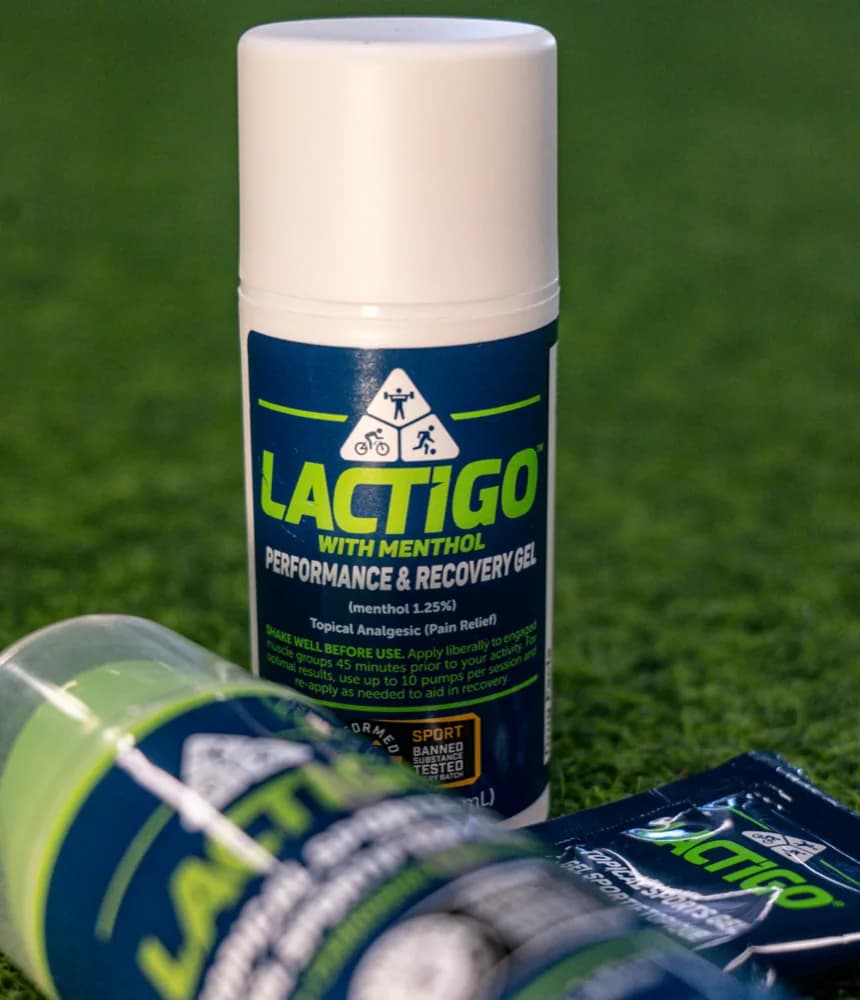
LactiGo Performance & Recovery Gel
Ten pumps a leg, forty-five minutes out. That is the whole method.
$55with menthol · 100 ml · about 5 sessions
10% off your first order through our link · 30-day money-back guarantee
Affiliate links. We earn a commission if you buy — it costs you nothing extra and does not change what we publish.
- Informed SportEvery batch tested
- 30 daysMoney-back guarantee
- 16,500+Athletes, per the brand
- 45 minApply before training